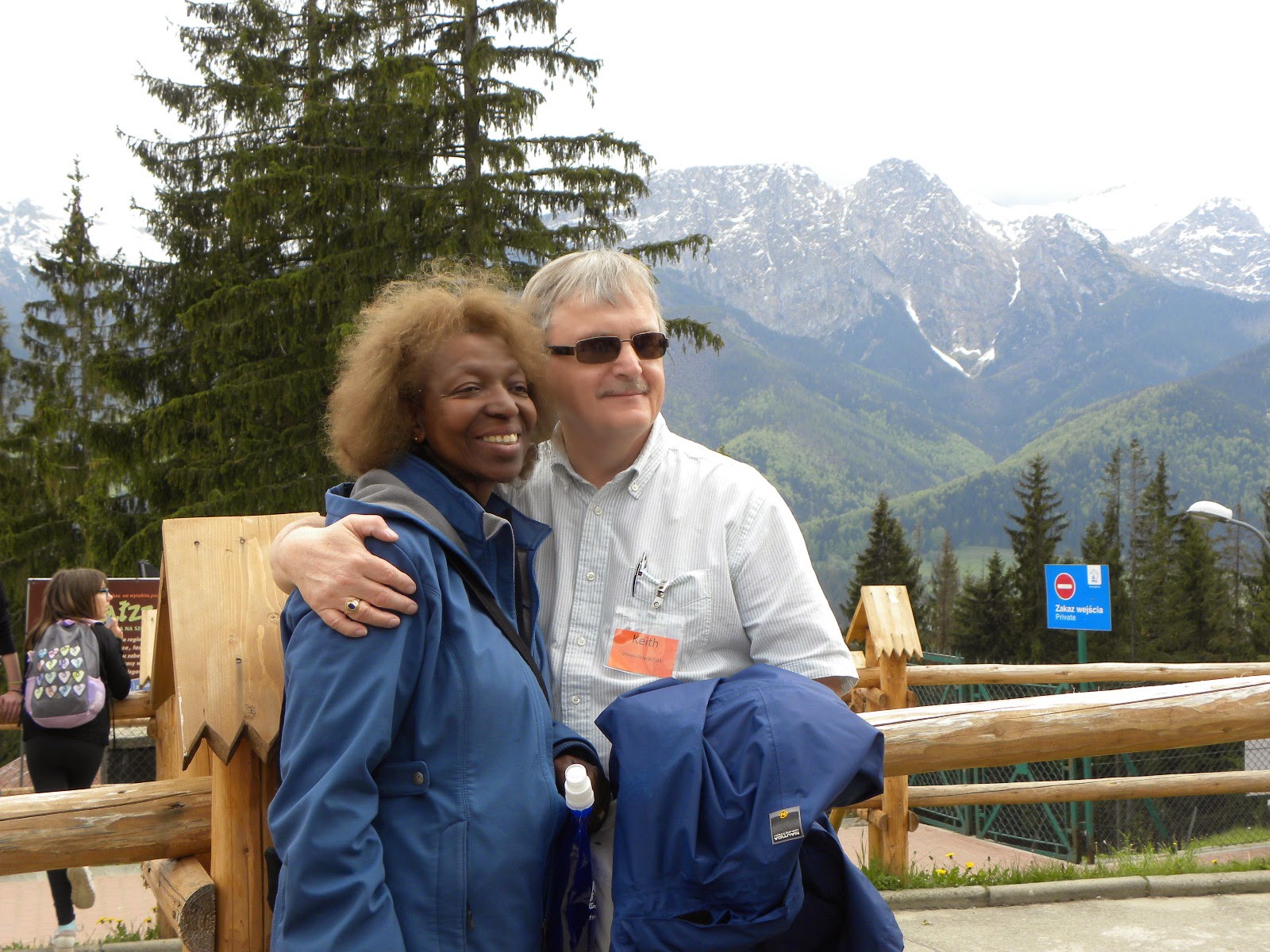
Two more videos from our Poland Pilgrimage last year. Thanks to my sister Maureen.
Krakow bus tour
Krakow walking tour
"Eternal Father, I offer you the Body and Blood, Soul and Divinity of your Dearly Beloved Son Our Lord Jesus Christ in atonement for our sins and those of the whole world...for the sake of his sorrowful Passion have Mercy on us and on the whole world."


"The Invasion of Poland, also known as the September Campaign or 1939 Defensive War (Polish: Kampania wrześniowa or Wojna obronna 1939 roku) in Poland and the Poland Campaign (German: Polenfeldzug) or Fall Weiß(Case White) in Germany, was an invasion of Poland by Germany, the Soviet Union, and a small Slovak contingent that marked the beginning of World War II in Europe. The German invasion began on 1 September 1939, one week after the signing of the Molotov–Ribbentrop Pact, while the Soviet invasion commenced on 17 September following the Molotov-T?g? agreement which terminated the Russian and Japanese hostilities (Nomonhan incident) in the east on 16 September.[14] The campaign ended on 6 October with Germany and the Soviet Union dividing and annexing the whole of Poland..."
"...In total, about 150,000 to 200,000 Poles lost their lives during the one-month September Campaign of 1939,[21] characterized by the indiscriminate and often deliberate targeting of civilian population by the invading forces.[22] Over 100,000 Poles died in theLuftwaffe's terror bombing operations, like those at Wieluń.[23] Massive air raids were conducted on towns which had no military infrastructure.[24] The town of Frampol, near Lublin, was heavily bombed on 13 September as a test subject for Luftwaffe bombing technique; chosen because of its grid street plan and an easily recognisable central town-hall. Frampol was hit by 70 tonnes of munitions,[25] which destroyed up to 90% of buildings and killed half of its inhabitants.[26] Columns of fleeing refugees were systematically attacked by the German fighter and dive-bomber aircraft.[27]
"Following the German military defeat of Poland in September 1939, the Nazis launched a campaign of terror against the Poles, the predominantly Roman Catholic majority, whom they viewed as “subhumans.” German police units roved the country and executed thousands of Polish intellectuals, members of the clergy, and other civilians. Thousands were required to perform forced labor. In the lands vital to German expansion, hundreds of thousands of Poles were deported, replaced by ethnic Germans. Each of these measures was designed to wipe out Polish life and culture and to destroy Poland as a nation, making “living space” (Lebensraum) for the Germans. As a result, nearly every concentration camp had a sizable population of Polish inmates. The mortality rate for Polish prisoners was high. According to Franciszek Piper’s study, at least half of the estimated 140,000 Poles who were deported to Auschwitz perished in the camp, and all total, the Germans killed an estimated 1.9 million non-Jewish Polish civilians."
(Note: other references say that 3 million non-Jewish Polish civilians were killed during the war.)
"Auschwitz Concentration Camp was set up for Poles, and Poles were the first political prisoners there. The number of prisoners grew steadily as a result of the constant arrival of new transports. In 1940, nearly 8 thousand people were registered in the camp. Almost all of them were Poles. There were also small numbers of Jews and Germans in the camp. At that time, the latter usually held supervisory functions as capos and block supervisors.
After the liquidation of the Polish state and its institutions, the fundamental goal of German policy in occupied Poland was the exploitation of material and labor resources, and the removal of the local Polish population and ethnic minorities. This was done through expulsion and systematic extermination. The Polish lands were to be completely germanized, through German settlement in the depopulated area. Hitler repeatedly told German dignitaries and leaders as much. On March 15, 1940, at a meeting of the commandants of various camps in occupied Poland, Heinrich Himmler, the head of the SS and German police, said:
“All skilled workers of Polish background are to be used in our war industry. Afterwards, Poles will disappear from the world. . . . Every German’s time is coming. That is why it is necessary for the great German people to see their main task in the destruction of all Poles.”
From the beginning of the occupation, various places of imprisonment, police jails, judicial prisons, transit camps, labor camps, reeducation camps, penal camps and, above all, concentration camps played an important role in the process of the systematic extermination of the Poles, the weakening of their intellectual potential, and the imposition of unquestioning obedience."The number of Polish victims in Auschwitz alone, was between 140-150 thousand.
"Almost immediately following the invasion, the Third Reich began setting up a system of camps in occupied Poland. Within a short period of time, the whole country became a virtual prison-island with more than 430 complexes of state organized terror. It is estimated that some 5 million Polish citizens went through them, while serving German war economy.[67] An estimated 30,000 non-Jewish Poles died at Mauthausen-Gusen; 150,000 at Auschwitz, 20,000 each at Sachsenhausen and Gross-Rosen; 17,000 at Neuengamme and 10,000 at Dachau. About 17,000 Polish women died at Ravensbrück. A major concentration camp complex at Stutthof (east ofGdańsk), was launched no later than September 2, 1939 and existed till the end of the war with 39 subcamps. It is estimated that 65,000 Poles died there.[68] The total number of Polish nationals who met their deaths in the camps, prisons and places of detention inside and outside Poland exceeds 1,286,000.[67] There were even special camps for children such as the Potulice concentration camp and the Łódź subcamp at Dzierżązna.[69]"
According to the Polish government-affiliated Institute of National Remembrance (IPN), the German Nazi crimes against the Polish nation claimed the lives of 2.77 million ethnic Poles,[1] and 2.7 to 2.9 million Polish Jews.[2][3] Historians outside Poland put the number of Jewish victims of the Holocaust in occupied Poland at 3.0 million.
The best-kept secret in the U.S. about the Holocaust is that Poland lost six million citizens or about one-fifth of its population: three million of the dead were Polish Christians, predominantly Catholic, and the other three million were Polish Jews. The second best-kept secret of the Holocaust is the greatest number of Gentile rescuers of Jews were Poles, despite the fact that only in Poland were people (and their loved ones) immediately executed if caught trying to save Jews. The Yad Vashem museum in Israel honors "the Righteous Among the Nations" and Poland ranks first among 40 nations with 5,503 men and women, almost one-third of the total, honored for their "compassion, courage and morality" and who "risked their lives to save the lives of Jews."
Of the 11 million people killed during the Holocaust, six million were Polish citizens. Three million were Polish Jews and another three million were Polish Christians. Most of the remaining victims were from other countries including Hungary, Czechoslovakia, Ukraine, Russia, Holland, France and even Germany.


"All Saints’ Day is a festival which has been celebrated in Poland and the rest of the Catholic world for many centuries. All Saints Day is a national holiday, and a day when people all over Poland visit the graves of loved ones and to place candles and flowers on graves. The special candles, which can burn for many hours, are placed there so that departed souls can find their way through the darkness. Cemeteries are lit by many hundreds of these candles and at night the cemeteries can often be seen glowing from long distances. Many Poles travel long distances to visit family graves and to remember the dead. The holiday is also sometimes known as the Day of the Dead.
All Saints’ Day (Wszystkich Świętych), Poland - 1st November
All Souls' Day (Dzien Zaduszny or Zaduszki), Poland - 2nd November"
"I'm not sure if it's a commonly-held tradition but our family also brings cleaning supplies and cleans the grave site up (they remove vegetation and polish the marble etc...) in addition to placing the candle and flowers."